Why a time & attendance system matters under the Employment Rights Act
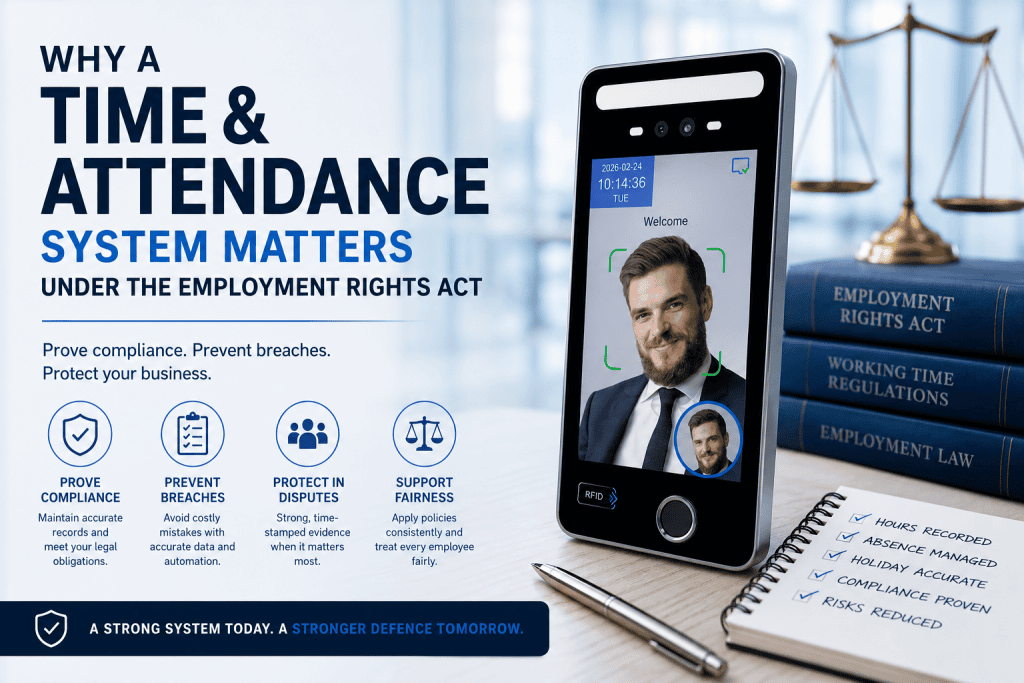
A proper system that records worked hours, absence, and absence entitlement does three big things under the ERA:
- Proves compliance
- Prevents accidental breaches
- Protects you in disputes
Here’s how that plays out, section by section.
1. Protection against unlawful deduction of wages (ERA s13)
ERA requirement
Employers must not make unauthorised deductions from wages.
Risk without a system
- Estimated hours
- Manual adjustments
- Disputes over “I worked that shift”
- Pay withheld due to undocumented absence
Benefit of a time & attendance system
- Objective record of hours worked
- Clear link between attendance and pay
- Evidence that deductions (if any) are lawful and contractual
Employer win:
If challenged, you can prove pay is correct — not just argue it.
2. Accurate holiday entitlement & holiday pay (ERA s13 + Working Time Regulations)
ERA connection
While holiday is mainly WTR, holiday pay errors become wage deduction claims under the ERA.
Risk without a system
- Incorrect accrual for part-time or irregular hours
- Rolled-up holiday pay mistakes
- Over/under-payment during leave
Benefit
- Automatic entitlement calculation
- Clear record of taken vs remaining leave
- Accurate holiday pay based on real earnings
Employer win:
Avoids backdated claims, which can stack up fast.
3. Evidence in unfair dismissal and redundancy claims (ERA Part X)
ERA requirement
Dismissals must be fair and supported by evidence.
Risk without a system
- Absence records based on manager memory
- Inconsistent application of attendance policies
- Subjective assessments challenged in tribunal
Benefit
- Consistent, time-stamped absence data
- Objective attendance history
- Clear thresholds applied equally
Employer win:
Attendance-based decisions are defendable, not debatable.
4. Managing statutory leave & sickness correctly (ERA Part VIII)
ERA requirement
Employees must not suffer detriment for taking statutory leave or sick leave.
Risk without a system
- Sickness recorded incorrectly as unauthorised absence
- Statutory leave mixed up with contractual leave
- Inconsistent treatment across teams
Benefit
- Clear categorisation of absence types
- Automatic entitlement tracking
- Reduced risk of accidental detriment
Employer win:
Protects against discrimination-by-error.
5. Day-one rights & worker status scrutiny
ERA trend
More rights apply from day one, including pay transparency and leave.
Risk without a system
- No reliable record for short-service staff
- Casual workers’ hours disputed
- Worker vs employee status challenged
Benefit
- Clear proof of hours, patterns, and control
- Supports correct classification
Employer win:
Reduces exposure where status is questioned.
6. Tribunal credibility & burden of proof
Reality of ERA enforcement
In many cases, the employer is expected to produce records.
Risk without a system
- Spreadsheets edited after the fact
- Incomplete or inconsistent records
- Over-reliance on witness statements
Benefit
- Time-stamped records
- Centralised data
- Consistent methodology
Employer win:
Your evidence looks credible before you even speak.
7. Consistency = fairness under the ERA
The ERA doesn’t just care about what you do — it cares about whether you do it consistently.
Benefit
- Rules applied the same way to everyone
- Fewer “exception-based” disputes
- Less managerial discretion causing risk
Employer win:
Consistency is one of the strongest tribunal defences.
The short version (for directors)
A time & attendance system can:
- ✔ Prevent unlawful wage deduction claims
- ✔ Reduce holiday pay exposure
- ✔ Strengthen dismissal and redundancy defences
- ✔ Protect against day-one and worker-status disputes
- ✔ Provide tribunal-grade evidence
- ✔ Demonstrate procedural fairness
In ERA terms, it turns:
“We believe we acted fairly”
into
“Here is the record proving we complied with the law.”